Tag: studio
-

TENTH STREET EXHIBITION
The Tenth Street Historic District Freedman’s Town is one of the few Landmark Historic Districts that remains in place in Texas and the nation. However, since its designation as a National Register of Historic Places in 1994, it has undergone intense demolition provoked by a lack of municipal oversight and resources in a historically neglected neighborhood. The work in this exhibition highlights an effort led by Texas Target Communities of Texas A&M University, Tenth Street Community members, and a large group of architecture students and faculty who engaged with the neighborhood in the Spring of 2024. The projects presented here…
-

PUBLIC ASSEMBLIES OF WORK
PUBLIC(S) ASSEMBLIES OF WORK was a graduate architecture studio at NJIT that considers what and who constitutes the publics (in plural) of the town of Harrison, New Jersey, and how their identification and critical analysis can inform the production of a program and a project for architecture, or an assembly of work. The studio investigated subjects, communities, legal frameworks, technology and contemporary forms of work that are informed by or resist the neoliberal logic of economical performance metrics as well as our service and sharing economies. The studio was informed by various authors ideas and research about work in a our…
-
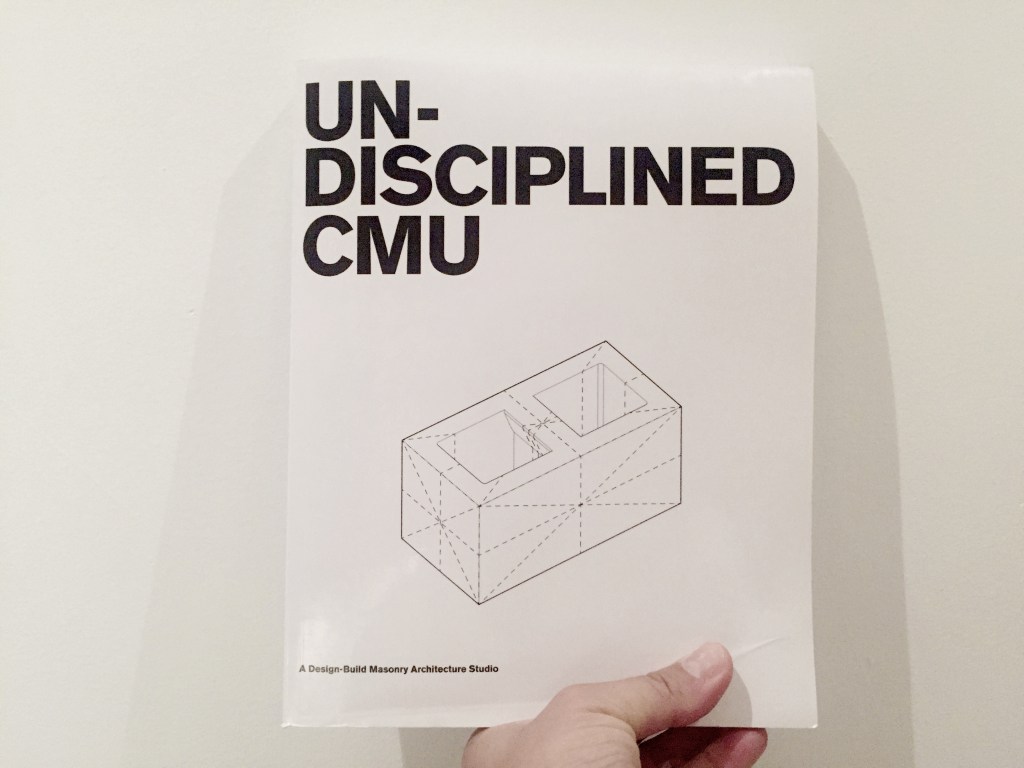
UNDISCIPLINED CMU: A DESIGN-BUILD MASONRY STUDIO
UNDISCIPLINED CMU: A DESIGN-BUILD MASONRY STUDIO is the book that document the project of the same name. The book was done during the Summer of 2015 in collaboration with Pier Paolo Pala, Chau Tran and Yuliya Veligurskaya, students who took part on the Spring semester making the project. The book is available for purchase here and to view online here. Studio Instructor, Editor, 2015.
-

UNDISCIPLINED CMU
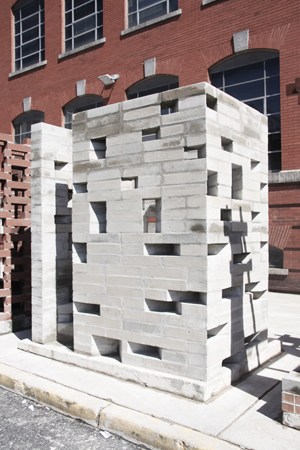
UNDISCIPLINED CMU is the second iteration of a second year undergraduate studio project at the New Jersey Institute of Technology in which a construction is developed as part of a masonry studio. Material is investigated as a given condition and turned into an unexpected object after intense exploration. The resultant object is a concrete construction that, as an education device, opened the possibilities of reimagining and reconsidering the banality of the most typical, and less valued material in the construction industry, by literally cutting it; aiming for an expanded consideration of disciplinary knowledge and industry in the academic setting. Students: Mariza Antonio, Spoorthi Bhatta, Rawad…
-

SPATIAL CONSTRUCTIONS
Spatial Construction: Occupying a Grid is an exercise for the Introduction to Architecture and Visual Culture studio for non-majors at Barnard and Columbia. It is focused on the better understanding of space within a set of given parameters. First, it will work around a virtual cubic structure (12″x12″)that will contain a formal grid. This will define one “spatial” and “formal” boundary to be enhanced, explored, challenged or disrupted. Second, following your home-to-studio-trip record and experience, you will elaborate a spatial construction based –but not limited to– your trip. Studio Instructor, 2015-16.
-

THE DAY AFTER THE CARNIVAL
The Day After the Carnival: The Hangover of Work (in Late Capitalism) was a graduate studio taught at Penn Design in the University of Pennsylvania, inquiring the intersection of work-production as a mode of carnivalesque action in the form of hangover. Students researched and draw existing program-buildings near Northern Liberties, analyzed their local-global logics, composed programmatic drawings, developed strategies and formulated and architectural assembly combining them all, including a large cultural programming. Studio Instructor, 2016.
-
CMU I
A complement to the 2nd year studios at the New Jersey Institute of Technology students work on a masonry build-mock-up, a competition based project in which students create a masonry construction with the help of masons, typical solid CMU blocks were cut in order to create the space of “staged interactions” within the school environment. The inquiry of the concrete masonry unit, the most typical construction element, offered the opportunity to reconsider a usually overlooked material and its capacities. First prize. Studio Instructor, 2014.
-

SYSTEMS AND TECTONICS
The core 2nd year studio at the New Jersey Institute of Technology aim to discuss and develop design strategies for the concepts of tectonics and buildings’ systems. The studio was given with an emphasis in experimenting with the tools of geometric and ordering systems and their networked capacity. Studio Instructor, 2014.
-

URBAN INTERVENTIONS I
Barnard + Columbia Introduction to Architecture and Visual Culture studio for non-majors in architecture. Students were asked to develop a Urban Intervention based on active verbs that they first enacted in person. Verbs were interpreted and informed by the students’ body through conceptual drawings, then translated into site-specific interventions. Studio Instructor, 2014.
-
PLACE AND CONTEXT STUDIO
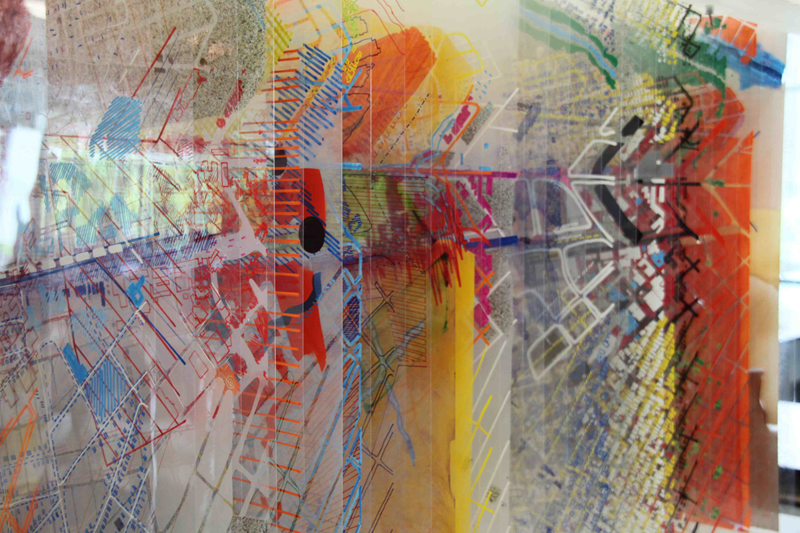
For the initial part of the course, first year undergraduate students where confronted to notions of place and context. An analytical city study was developed through the layering of cartographic drawings including a vast variety of the city’s visible and invisible infrastructure. Mixed media, hand drawn. Studio Instructor, 2007.
-
VALPARAISO OR AN ANAMNESTIC MEMORY
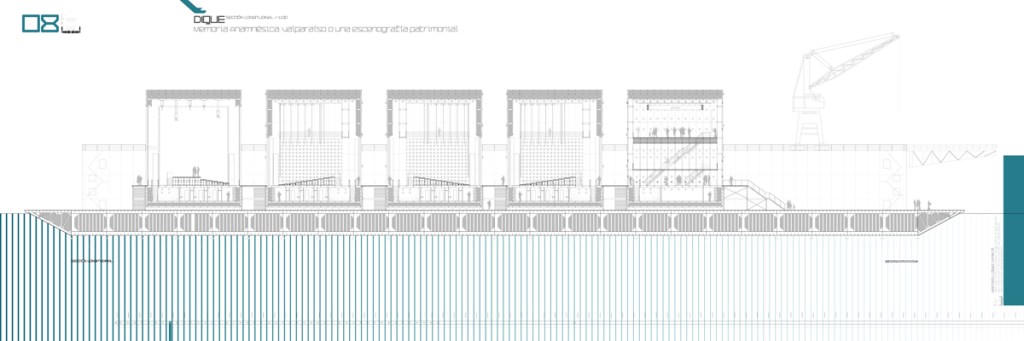
Memory is a vital resource for trying to explain cities. Valparaíso in Chile has been no exception as evidenced by the efforts that made the city a World Heritage Site (UNESCO) after this project began in 2002. Therefore, critical analysis of heritage-related memory could present operational and architectural alternatives in the exercise of articulating historical value. With this premise, the project proposes an alternative for the staging of the city through its “documents of the past,” with a scenery dominated by the transient and imagination as a tool of memory. The city’s geographic amphitheater-like formation strengthens the relationship with the…
 Marcelo López–Dinardi