Tag: 2014
-

SPATIAL CONSTRUCTIONS
Spatial Construction: Occupying a Grid is an exercise for the Introduction to Architecture and Visual Culture studio for non-majors at Barnard and Columbia. It is focused on the better understanding of space within a set of given parameters. First, it will work around a virtual cubic structure (12″x12″)that will contain a formal grid. This will define one “spatial” and “formal” boundary to be enhanced, explored, challenged or disrupted. Second, following your home-to-studio-trip record and experience, you will elaborate a spatial construction based –but not limited to– your trip. Studio Instructor, 2015-16.
-
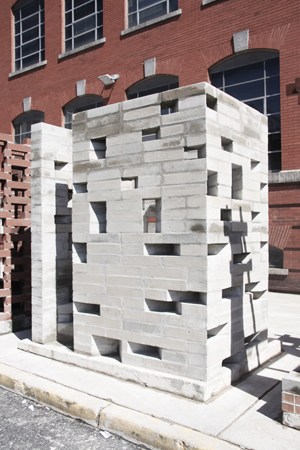
CMU I
A complement to the 2nd year studios at the New Jersey Institute of Technology students work on a masonry build-mock-up, a competition based project in which students create a masonry construction with the help of masons, typical solid CMU blocks were cut in order to create the space of “staged interactions” within the school environment. The inquiry of the concrete masonry unit, the most typical construction element, offered the opportunity to reconsider a usually overlooked material and its capacities. First prize. Studio Instructor, 2014.
-

SYSTEMS AND TECTONICS
The core 2nd year studio at the New Jersey Institute of Technology aim to discuss and develop design strategies for the concepts of tectonics and buildings’ systems. The studio was given with an emphasis in experimenting with the tools of geometric and ordering systems and their networked capacity. Studio Instructor, 2014.
-

URBAN INTERVENTIONS I
Barnard + Columbia Introduction to Architecture and Visual Culture studio for non-majors in architecture. Students were asked to develop a Urban Intervention based on active verbs that they first enacted in person. Verbs were interpreted and informed by the students’ body through conceptual drawings, then translated into site-specific interventions. Studio Instructor, 2014.
-
ARCHITECTURE OF INDUSTRIOUSNESS
Architecture of Industriousness is a short text part of House Housing: An Untimely History ofArchitecture and Real Estate in Nineteen Episodes, exhibition’s pamphlet, made for the traveling exhibition Venice’s Casa Muraro during the summer of 2014, and off-Venice Biennale site. Also available on the web at http://www.house-housing.com. Research and Production Coordinator for the Venice part of the exhibition by the Buell Center of the Study of American Architecture, 2014.
-

POST-SPECULATION ACT I
Post-Speculation Act I was an exhibition at P! Gallery featuring HOWDOYOUSAYYAMINAFRICAN. A project with A(n) Office, we designed the exhibition and installation of multimedia images and videos, as well as objects. 28 screens where displaying news and artists’ work related to urgent racial issues, subverting the typical surveillance display into a revealing and exposure device. It engaged the public audience of the street outside as well as the gallery visitors from within. Designer, 2014.
-

VISITING SPLITTING
Visiting Splitting was a film screening and conversation held around two films depicting Gordon Matta-Clark’s Splitting work, including the film Visit To Humphrey Street House, a first public screening after revealing the film from the artist’s archive. In discussion with Kelly Baum, Jessamyn Fiore, GH Hovagimyan and Mark Wigley. Event held at the Storefront for Art and Architecture. Moderator, Organizer, 2014. More info about the event, including video documentation, can be found here.
-

PROMISCUOUS ENCOUNTERS
Promiscuous Encounters, a day-long event held at the GSAPP in March 2012, examined the interplay between the critical, curatorial, and conceptual capacities of architecture, neither audio nor video recordings were made. This publication is, then, the vehicle for the event’s documentation and the site where the interpretations of both participants and audience are made public, thereby contributing to build up the vocabulary for a theory of promiscuous practice. Contributors: Keller Easterling, Andrés Jaque, Reinhold Martin, Mitch McEwen, Markus Miessen, Felicity D. Scott, Pelin Tan, Rodrigo Tisi, and Mark Wasiuta. Publisher: GSAPP Books / Columbia Books on Architecture and the City.…
 Marcelo López–Dinardi